The $500,000 commercial appraisal threshold, explained
Since 2018, federally regulated banks can support many commercial real estate loans of $500,000 or less with an evaluation instead of an appraisal. Here is how the threshold and its neighbors work.
Federal appraisal regulations, adopted by the OCC, the Federal Reserve and the FDIC under Title XI of FIRREA, require an appraisal by a certified or licensed appraiser for real estate-related financial transactions, with a list of exemptions. Several of those exemptions replace the appraisal with an evaluation. The best known is the commercial real estate threshold.
The commercial real estate threshold: $500,000
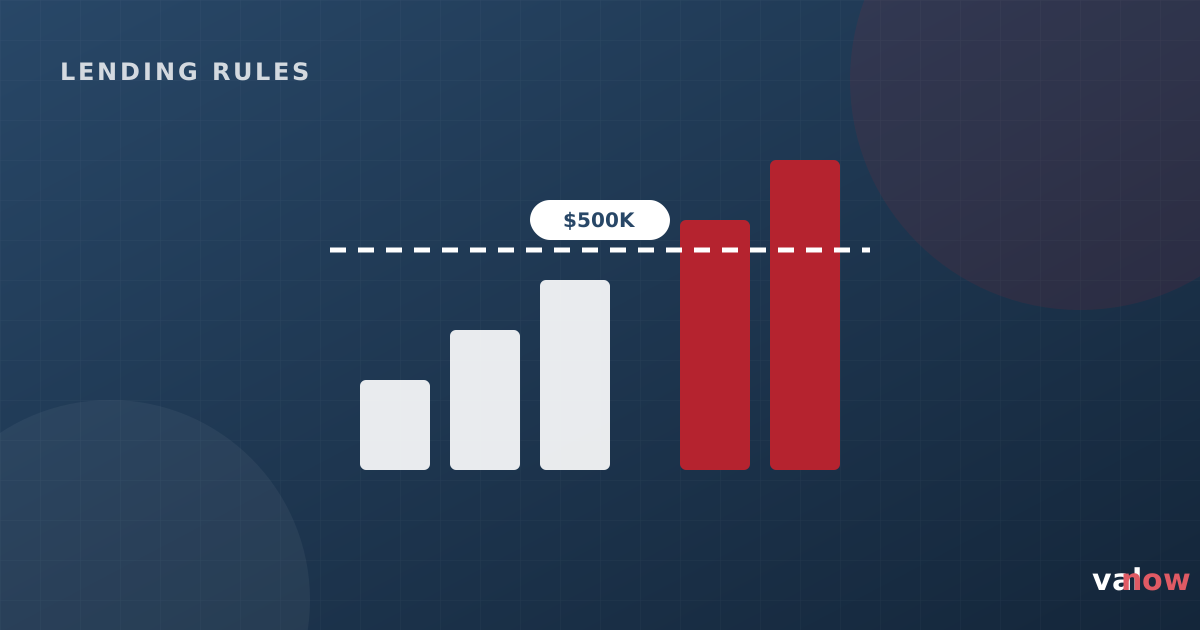
In April 2018, the three agencies raised the threshold for commercial real estate transactions from $250,000 to $500,000. The rule took effect on April 9, 2018. A commercial real estate transaction is defined as one that is not secured by a single 1-to-4 family residential property.
For a commercial transaction at or below $500,000, an appraisal is not required, but the institution must obtain an evaluation consistent with safe and sound banking practices. The agencies were explicit that banks may still order an appraisal for these loans when the risk justifies it.
The other common exemptions
| Transaction | Threshold or condition | Requirement |
|---|---|---|
| Commercial real estate | $500,000 or less | Evaluation |
| Business loan secured by real estate | $1,000,000 or less, when repayment does not depend primarily on the sale of, or rental income from, the real estate | Evaluation |
| Residential (1-to-4 family) | $400,000 or less, since 2019 | Evaluation |
| Existing extension of credit (renewal, refinancing) | No obvious and material change in the market or the property that threatens the collateral protection, or no new money beyond reasonable closing costs | Evaluation |
There are other exemptions, for example when real estate is taken as collateral out of an abundance of caution, or for certain loans guaranteed or insured by a government agency. Credit unions follow the NCUA's own appraisal rule, which sets different thresholds.
How the threshold is measured
The threshold applies to the transaction value, which for a loan is generally the amount of the loan or extension of credit, not the value of the property. A $450,000 loan on a $900,000 building is under the threshold; a $600,000 loan on the same building is not. Splitting a loan into pieces to stay under the threshold is not acceptable.
When an appraisal is still the better choice
An exemption allows an evaluation; it does not require one. The Interagency Appraisal and Evaluation Guidelines expect an institution's policy to call for an appraisal on exempt transactions when the risk warrants it, for example:
- a high loan-to-value ratio or a thin debt service coverage;
- an unusual or special-purpose property with few comparable sales;
- a market that is changing quickly;
- a borrower whose repayment depends heavily on the property's performance;
- a property with known environmental or physical issues.
What the evaluation must contain
An evaluation for an exempt transaction must still support the value: the property's location and description, the value conclusion, the method and analysis, the inspection performed, the data sources, the effective date and the preparer. We cover each element in what a commercial evaluation must contain.
Putting it into practice
Many community banks now route every commercial request of $500,000 or less to an evaluation track, with an automated valuation used first to screen the deal. Valnow for lenders supports both steps: a Valuation in about a minute for screening, and an Evaluation drafted for your valuer to complete and sign.
This article is general information, not legal or regulatory advice. Check your institution's policies and your regulator's current guidance before applying it to a loan.