Reconciliation: from three approaches to one defensible value
Reconciliation is where a valuer's judgment shows. It is not an average: it is an argument for why one indication deserves more weight than another.
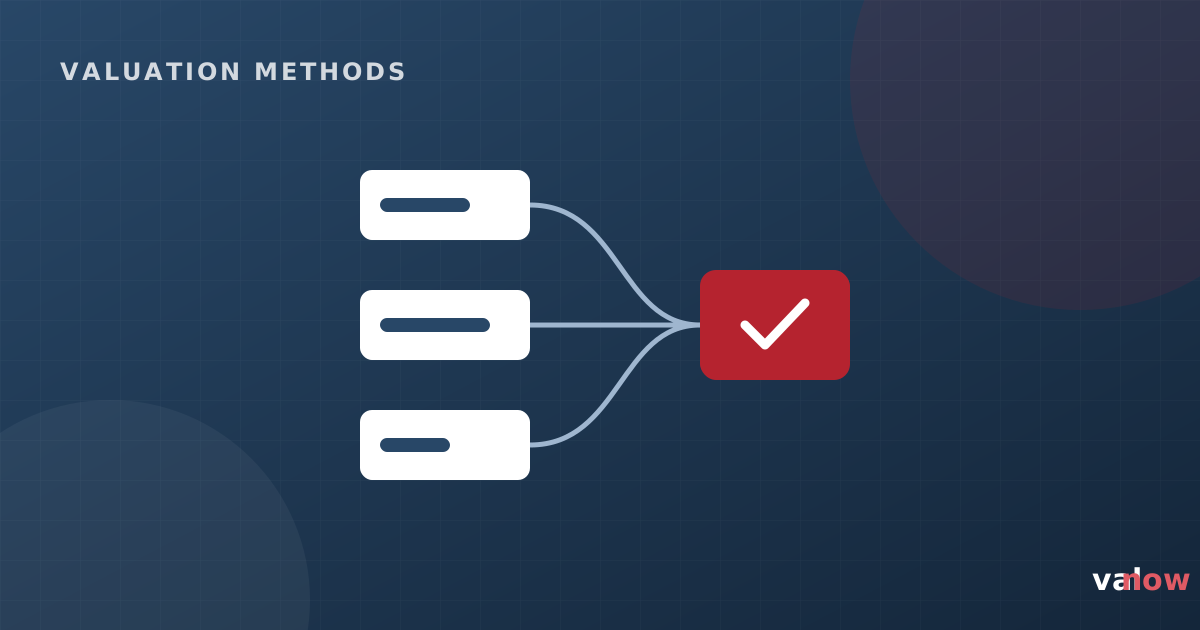
A commercial evaluation often produces two or three indications of value: one from the sales comparison approach, one from the income approach, and sometimes one from the cost approach. An automated valuation model can add a fourth, independent indication. Reconciliation turns them into a single conclusion, and explains why.
Three questions for each approach
For each indication, ask:
- Relevance: does this approach reflect how buyers of this property actually price it?
- Quantity and quality of data: how many good comparables, how reliable the income, how current the costs?
- Size of adjustments: how far did the analysis have to travel from the raw data to the indication?
Which approach usually leads
| Property | Usually most weight | Why |
|---|---|---|
| Multi-tenant income property | Income approach | Investors price it on its income |
| Owner-occupied building | Sales comparison | Buyers are users comparing similar buildings |
| New or special-purpose building | Cost approach, with care | Few comparable sales; cost reflects what a buyer would otherwise spend |
| Older building with heavy depreciation | Sales or income | Depreciation is hard to measure, which weakens the cost approach |
Using an AVM as a cross-check
A model value is useful in reconciliation because it is independent of the valuer's choices. When the concluded value is close to the model, it is reassuring. When it is far, the gap is worth explaining: a lease the model cannot see, a recent renovation, or a comparable set that may be skewed. The model can also carry some weight when its confidence is high and the local comparables are thin.
Weights, and their limits
Expressing the reconciliation as weights, for example 40% income, 30% sales comparison and 30% model, makes the reasoning transparent and easy to review. But the weights must add up to 100%, and they should follow from the three questions above, not from the value you want. Avoid giving weight to an approach you did not develop properly.
Explain the spread
If the indications are close, say so: agreement between independent approaches is strong support. If they are far apart, explain the main reason before concluding. A reviewer is far more comfortable with a wide spread that is explained than with a narrow one that is not.
Conclude and round
The concluded value should be rounded to a degree that reflects its precision, for example to the nearest $5,000 or $10,000 for a property in the low millions. State the effective date, the property rights valued, and any extraordinary assumptions.
A worked example
| Approach | Indication | Weight |
|---|---|---|
| Income approach | $1,240,000 | 40% |
| Sales comparison | $1,290,000 | 30% |
| Valnow model | $1,210,000 | 30% |
| Weighted indication | $1,246,000 | 100% |
| Concluded value | $1,250,000 |
The narrative would note that the income approach leads because the property is multi-tenant, that the sales comparison relies on four sales with moderate adjustments, and that the model, independent of both, lands within 4% of the conclusion.
In a Valnow Evaluation
Valnow Evaluation shows each approach, the Valnow model value and your weights side by side, checks that the weights total 100% before applying them, computes the weighted indication, and lets you set the concluded value. The concluded value is yours.
This article is general information, not legal or regulatory advice. Check your institution's policies and your regulator's current guidance before applying it to a loan.