AVM confidence scores: how to read them, and when to rely on them
A model value without a measure of confidence is a number without context. Here is what a confidence score tells you, what it does not, and how to turn it into a lending policy.
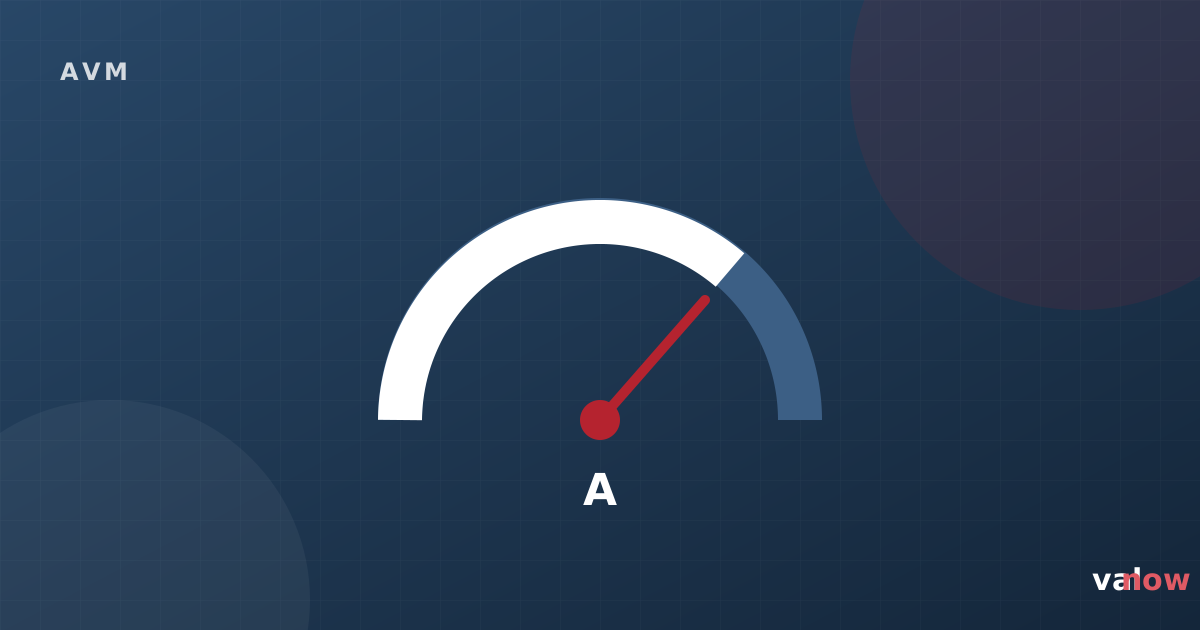
Every automated valuation is uncertain. Two office buildings with the same size and age on the same street can sell 20% apart because of their leases, their condition or the buyer. A good AVM does not hide this: it tells you how much to trust each estimate. That is the job of the confidence score.
What a confidence score measures
A confidence score summarizes the expected error of the estimate, based on how the model performed on similar properties: same property type, same market, similar data available. A higher score means the model has historically been closer to actual sale prices for properties like this one.
At Valnow, the score is shown as a percentage and a grade from A to C, and it is displayed before you accept the analysis. If it does not meet your needs, you do not pay.
What it does not mean
A confidence score of 88% does not mean there is an 88% chance the value is exactly right. It is a summary of expected error, not a probability. To understand what it implies in practice, look at the reliability figures next to it.
Reliability: the figure that makes the score concrete
A reliability analysis answers a simple question: when the model valued properties of this type in this market in the past, how often was it close to the actual sale price? For example:
For office properties in this MSA, past Valnow estimates were within 15% of the sale price 49% of the time, within 25% 77% of the time, and within 35% 95% of the time.
These figures are specific to the property type and the MSA, which is what a credit officer needs. A national average hides the difference between a deep market and a thin one.
What lowers confidence
- Few comparable sales in the market or for the property subtype.
- An unusual property: very large, very old, or special-purpose.
- Missing income data: for income property, a model with a reliable NOI is usually more precise.
- An NOI far from the market: an income far above or below the county's median NOI for the property type is either a data error or an unusual property. Valnow flags differences above 20% as you enter them, asks you to confirm large ones, and lowers the confidence score accordingly. See how to normalize NOI.
Turning the score into policy
Lenders get the most from confidence scores when they set thresholds by use:
| Use | A reasonable approach |
|---|---|
| Deal screening | Any grade, read with the range. A low grade is a signal to dig, not a reason to decline. |
| Portfolio monitoring | Track the trend in value and grade over time; flag large drops for review. |
| Supporting an evaluation | Use the model as one approach and a cross-check, with a higher weight when the grade is high and the comparables are thin, and a lower one when it is low. |
| Higher-risk loans | The score does not replace an appraisal when the risk calls for one. |
Write the thresholds into your appraisal and evaluation program, and test them periodically against the values you see at closing.
Read the range, not just the point
The point estimate is the model's best single value, but the relevant range is what a credit decision should consider. A loan that works at the bottom of the range is a stronger loan than one that only works at the point estimate.
Try it on a property you know: your first Valnow Valuation is free.
This article is general information, not legal or regulatory advice. Check your institution's policies and your regulator's current guidance before applying it to a loan.